Profiting from Chaos: How Sophisticated US Traders Monetize Crypto Volatility Instead of Fearing It
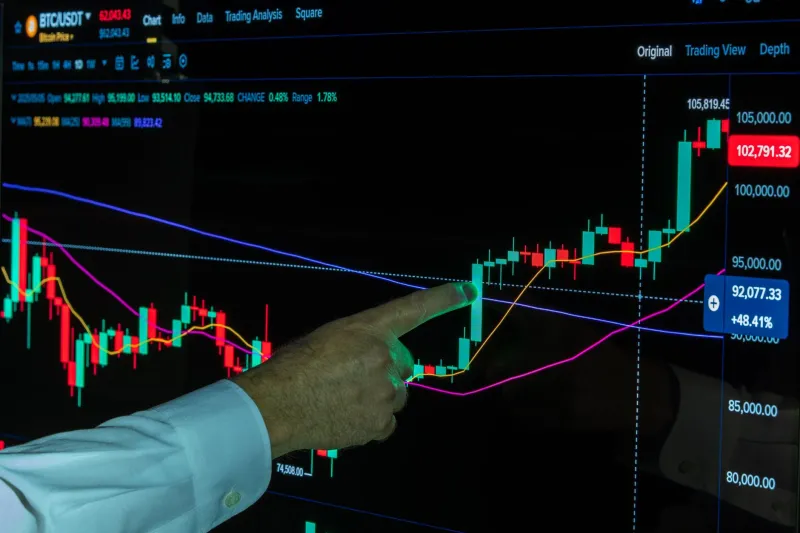
For most retail participants in the US crypto market, volatility is something to endure—a source of anxiety that triggers impulsive decisions and erodes carefully built positions. But behind the fear lies an underappreciated truth: volatility itself has a price, and that price fluctuates in predictable cycles. Traders who understand this dynamic can construct strategies that generate returns regardless of whether Bitcoin rises, falls, or moves sideways.
This is not a fringe concept. In traditional financial markets, volatility trading has been a core institutional discipline for decades. The crypto market, with its extreme price swings and maturing derivatives ecosystem, now offers retail investors meaningful access to similar frameworks. The key is understanding what volatility actually measures—and how to read its signals before the broader market reacts.
Beyond Standard Deviation: The Metrics That Actually Matter
Standard deviation is the most commonly cited volatility measure, but it is also among the least actionable for active traders. It describes past price dispersion without distinguishing between the direction or clustering of those moves. For practical trading purposes, several alternative metrics provide sharper insight.
Realized Volatility (RV) measures how much an asset actually moved over a defined historical window—typically calculated using high-frequency return data. Comparing 7-day realized volatility to 30-day realized volatility, for instance, can reveal whether a market is entering or exiting a turbulent phase.
Implied Volatility (IV) is derived from options pricing and represents the market's forward-looking expectation of price movement. When IV is significantly higher than recent realized volatility, options are considered expensive—a condition that often favors strategies built around selling premium. When IV is unusually compressed, options become cheap, and buying volatility exposure can offer asymmetric upside.
The IV-RV Spread, sometimes called the volatility risk premium, is perhaps the most actionable signal of all. Historically across both equity and crypto markets, implied volatility tends to exceed realized volatility on average. This gap represents the premium the market pays for uncertainty protection—and it can be harvested systematically by traders who understand when and how to position around it.
Platforms such as Deribit and certain US-accessible derivatives venues now publish volatility indices for Bitcoin and Ethereum, providing retail traders with the kind of data infrastructure that was once exclusive to institutional desks.
Volatility Cycles in Crypto: Reading the Compression-Expansion Pattern
Crypto volatility does not move randomly. It follows a recognizable compression-expansion cycle that, once understood, becomes one of the more reliable frameworks in digital asset trading.
Periods of low volatility—characterized by tight price ranges, declining trading volume, and narrowing Bollinger Bands—tend to precede significant directional moves. These compression phases are not signs of a stable market; they are often the calm before a structural shift. Traders who identify them early can position for the expansion that follows, either by purchasing options straddles (profiting from a large move in either direction) or by scaling into positions with tightly defined risk parameters.
Conversely, following sharp market dislocations—the kind that make headlines and trigger panic selling—volatility typically spikes and then mean-reverts. This post-spike environment is frequently where premium-selling strategies perform best, as options prices remain elevated relative to the actual turbulence that follows.
The 2022 FTX collapse, the March 2020 COVID shock in crypto markets, and the May 2021 China mining ban all produced similar patterns: extreme implied volatility followed by a gradual normalization. Traders who sold options in the days and weeks following each event—when fear remained elevated but actual price movement had already subsided—captured meaningful returns.
Practical Instruments: Options, Volatility Products, and Structured Approaches
For US-based traders, accessing volatility-focused strategies requires navigating a regulatory landscape that limits certain instruments. Offshore platforms with robust options markets may not be accessible to Americans without specific account structures, and compliance with IRS reporting requirements adds a layer of complexity that cannot be ignored.
That said, several practical pathways exist.
Bitcoin and Ethereum options on regulated venues provide the most straightforward access. Strategies such as short straddles or strangles (selling both call and put options at the same or different strikes) allow traders to collect premium when they believe the market will remain range-bound. The risk, however, is substantial if a large directional move occurs—position sizing and defined maximum loss thresholds are non-negotiable components of responsible execution.
Long straddles and strangles flip this dynamic, allowing traders to profit from large moves in either direction. These are particularly relevant ahead of known catalysts—Federal Reserve policy announcements, major protocol upgrades, or regulatory decisions—where implied volatility may be underpriced relative to the actual uncertainty present.
Volatility-targeted position sizing is a more accessible approach for traders who do not use options at all. Rather than allocating a fixed dollar amount to each trade, volatility-targeted sizing adjusts exposure inversely to current realized volatility. When Bitcoin's 30-day RV is elevated, positions shrink. When it compresses, positions expand. This mechanical approach prevents the common mistake of holding oversized positions into high-volatility regimes—exactly when maximum drawdowns tend to occur.
The Behavioral Advantage: Why Most Traders Get This Wrong
The deeper edge in volatility trading is not technical—it is behavioral. Most retail participants are conditioned to treat price stability as safety and price swings as danger. This instinct, while understandable, is precisely backward from a probabilistic standpoint.
High-volatility environments, while uncomfortable, often present the most favorable risk-reward setups for disciplined traders. Wide bid-ask spreads and elevated options premiums create opportunities for those willing to act with structure rather than emotion. Low-volatility environments, despite feeling safer, can lull traders into complacency and oversized positions that become catastrophic when compression finally breaks.
Developing a systematic framework for measuring volatility—rather than simply reacting to it—is what separates traders who consistently extract value from those who remain perpetually at the market's mercy. Tracking IV levels weekly, comparing them to realized volatility over multiple timeframes, and maintaining a log of how different strategies performed across volatility regimes builds the kind of pattern recognition that no single article can fully replicate.
Building a Volatility-Aware Framework at CoinRokka
At CoinRokka, our perspective on trading strategy has always emphasized process over prediction. Volatility trading exemplifies this philosophy: it does not require knowing where Bitcoin will trade next week. It requires understanding the structure of uncertainty itself—how it is priced, how it cycles, and how to position around it with defined risk.
For US investors willing to invest the time in learning options mechanics and volatility metrics, this represents one of the more durable edges available in the digital asset market. It is not a shortcut, and it carries real risk if applied without discipline. But for those who approach it systematically, the volatility that frightens most traders becomes, quite literally, a source of return.
The market will always produce uncertainty. The question is whether you are paying for it—or collecting the premium.


