The Gap Between Bitcoin's Price and Your Actual Returns: What US Traders Rarely Account For
Every few months, financial headlines announce another impressive Bitcoin or Ethereum rally. Social media lights up. Portfolio dashboards flash green. And yet, when US traders sit down to calculate what they actually earned—after fees, taxes, mistimed entries, and hidden execution costs—the number rarely matches the headline.
This is not a rare edge case. It is a structural feature of how most retail participants engage with crypto markets. Understanding why that gap exists, and how to systematically narrow it, is one of the more consequential skills an active trader can develop.
Why Headline Returns Are a Misleading Benchmark
When financial media reports that Bitcoin gained 30% over a given quarter, that figure measures the move from a specific open price to a specific close price—a clean, frictionless number that no actual trader ever captures in full. Real-world portfolio returns are shaped by a chain of small but compounding deductions that begin the moment a trader decides to act.
The first and most obvious deduction is transaction fees. On centralized exchanges, maker and taker fees typically range from 0.05% to 0.50% per trade depending on volume tier and platform. For a trader who enters a position, adjusts it mid-cycle, and then exits in stages, four to six transactions is not unusual. At 0.20% per trade, that alone consumes over 1% of notional value before any market movement is factored in. On decentralized platforms, gas fees and protocol charges can be considerably higher, particularly during periods of network congestion.
Slippage compounds this further. In liquid markets like BTC/USD on major exchanges, slippage may appear negligible. But for traders operating with larger position sizes, or those using market orders during volatile sessions, the difference between the quoted price and the actual fill price erodes returns in ways that rarely appear on a brokerage statement as a distinct line item.
The Timing Problem: Entering After the Move Has Already Happened
Perhaps the most significant driver of the gap between index returns and personal portfolio performance is entry timing. Retail traders disproportionately enter positions after a move has already attracted media attention—which, by definition, means after a substantial portion of the gain has already occurred.
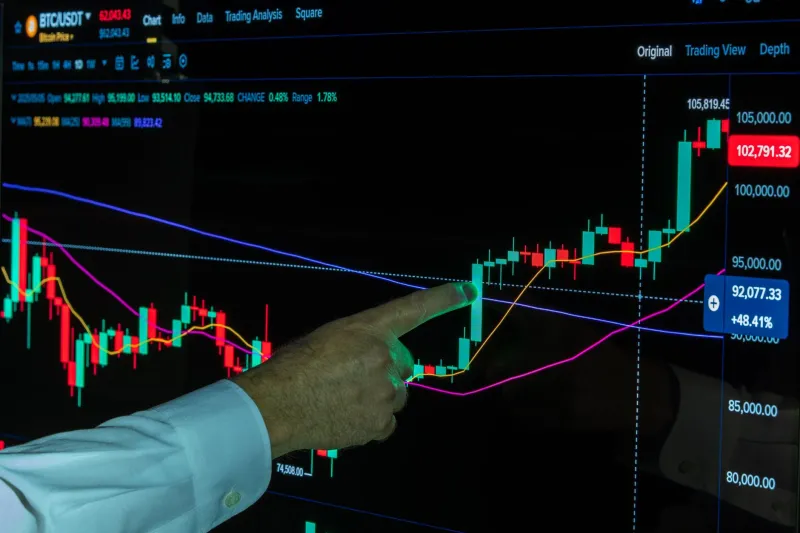
Consider a scenario where Bitcoin moves from $60,000 to $78,000—a 30% advance. A trader who reads about the rally when Bitcoin crosses $70,000 and enters there captures only $8,000 of the move, representing roughly 11.4% on their cost basis rather than 30%. This is not a hypothetical; it reflects a well-documented behavioral pattern in retail market participation across asset classes, and crypto's 24-hour news cycle accelerates the dynamic considerably.
Exit timing introduces a mirror-image problem. The same emotional forces that delay entry—fear of missing out, waiting for confirmation—tend to delay exit as well. Traders who hold through a retracement hoping for a higher high often give back a meaningful portion of unrealized gains before finally closing the position.
Tax Drag: The Cost That Compounds Across Cycles
For US-based investors, the tax treatment of cryptocurrency creates a drag that is easy to underestimate and difficult to reverse. The IRS classifies cryptocurrency as property, meaning each disposal event—a sale, a trade, or even certain DeFi interactions—is a taxable event that must be reported.
Short-term capital gains, applicable to assets held under one year, are taxed at ordinary income rates, which can reach 37% for higher earners. A trader who captures a 30% gain on a position held for eight months may see the after-tax return fall to roughly 19% or lower depending on their marginal rate. When this is layered onto the entry timing and fee deductions already described, the actual realized gain relative to the advertised rally shrinks considerably.
Long-term capital gains treatment—available for positions held over one year—significantly improves the picture, but it requires a level of patience that many active traders find difficult to maintain in a market characterized by sharp drawdowns and frequent narrative shifts.
Hidden Costs in Portfolio Construction
Beyond individual trade mechanics, the structure of a broader crypto portfolio introduces additional sources of return erosion. Traders who diversify across multiple assets often find that their allocation to Bitcoin or Ethereum is smaller than they intend, because high-volatility altcoins demand disproportionate mental and capital bandwidth.
Rebalancing costs also accumulate quietly. A portfolio that is rebalanced monthly to maintain target allocations generates twelve sets of taxable events per year, each carrying its own fee and potential tax liability. Research across traditional and digital asset portfolios consistently shows that mechanical rebalancing, while theoretically sound, often underperforms a simpler buy-and-hold approach on an after-tax, after-fee basis—particularly in trending markets.
Stablecoin holding periods represent another overlooked drag. Traders who move in and out of stablecoins between positions are effectively sitting in cash during periods when the underlying asset may be appreciating. While this reduces drawdown risk, it also reduces the time the capital is working, shrinking the effective return relative to the asset's full-cycle performance.
What Disciplined Traders Do Differently
The traders who consistently capture a higher percentage of a given market move share several observable practices.
First, they establish entry criteria before a rally attracts widespread attention—typically through systematic monitoring of on-chain signals, technical levels, or macro triggers rather than reacting to headlines. This does not mean they always enter at the optimal price, but it means they are rarely entering after the majority of the move has already occurred.
Second, they are deliberate about fee structures. This means selecting exchange tiers that match their actual volume, using limit orders where execution timing permits, and being conscious of how frequently they are transacting within a given position lifecycle.
Third, they plan for taxes at the time of entry, not exit. Knowing in advance whether a position is likely to be held for long-term treatment shapes how they structure partial exits and how they think about rebalancing. Many sophisticated traders maintain a simple log that tracks cost basis, holding period, and estimated tax liability in real time.
Finally, they measure performance against a realistic benchmark—not the clean price chart, but their own after-fee, after-tax, time-weighted return. That discipline, unglamorous as it is, tends to produce better decisions over multiple market cycles.
Closing the Gap
Crypto markets offer genuine return potential that few other asset classes can match in terms of magnitude or speed. But that potential is systematically eroded for traders who treat headline price performance as a proxy for what they will actually earn.
The 30% Bitcoin rally that becomes a 12% portfolio gain is not a mystery—it is the predictable result of fees, timing, tax drag, and structural portfolio friction operating in combination. Recognizing each of those forces, and building habits that address them individually, is how disciplined US traders begin to capture more of the move that the market actually provides.