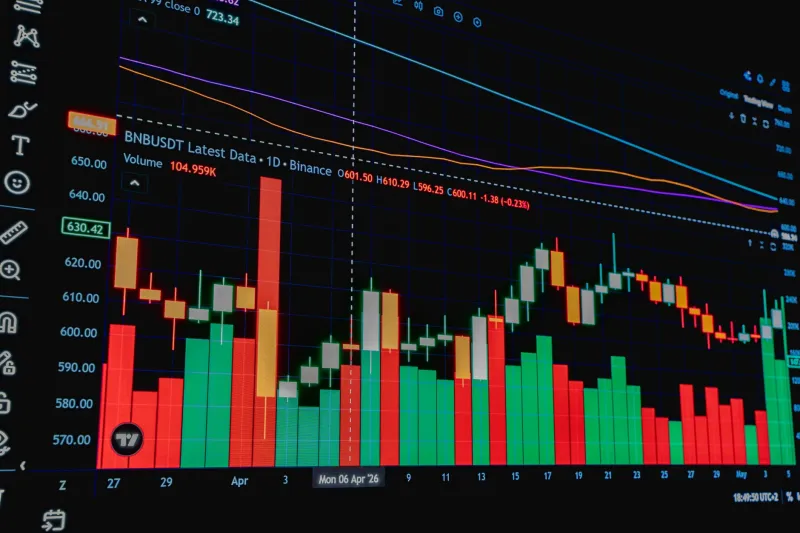
When Crypto Stops Being a Hedge: The Structural Shift Rewriting Portfolio Assumptions

The Premise That Built a Portfolio Thesis
For much of Bitcoin's early institutional life, the pitch was straightforward: digital assets move independently of stocks, bonds, and macro cycles. That narrative attracted pension consultants, family offices, and retail investors alike—all seeking something that wouldn't bleed out when the S&P 500 did. The math, for a time, seemed to support it. During certain market dislocations between 2018 and 2021, Bitcoin did indeed chart its own course, occasionally rallying while equities faltered.
That story has become significantly harder to tell in 2024 and 2025. The correlation between Bitcoin and the Nasdaq 100, in particular, has tightened in ways that unsettle the original diversification argument. When the Federal Reserve telegraphs a hawkish pivot, crypto doesn't shrug. It sells off—often harder than equities. When risk appetite contracts, digital assets don't act as a refuge. They amplify the damage.
Understanding why this has happened isn't just an academic exercise. For US investors who built allocation strategies around crypto as a hedge, the structural shift demands a serious reassessment.
What the Data Actually Shows
Correlation between asset classes is never static, and cryptocurrency has always been volatile enough to produce misleading short-term readings. But the pattern that has emerged through 2024 into 2025 reflects something more durable than noise.
During the market stress events of early 2025—driven by renewed uncertainty around Federal Reserve rate policy and geopolitical trade disruptions—Bitcoin and major altcoins declined sharply in tandem with US equities. The 30-day rolling correlation between Bitcoin and the Nasdaq 100 climbed above 0.70 during several of these episodes, a level that effectively eliminates the diversification benefit that many investors assumed they were purchasing.
This isn't a single anomaly. The pattern has repeated with enough consistency that analysts at several major financial institutions have revised their portfolio construction frameworks to treat crypto as a risk-on asset rather than an alternative one.
Three Structural Forces Behind the Shift
Institutional Adoption Has Anchored Crypto to the Risk Cycle
The very success that legitimized digital assets in mainstream finance has also embedded them into the same behavioral ecosystem as traditional risk assets. Institutional investors—hedge funds, asset managers, and increasingly ETF-driven retail flows—treat Bitcoin as part of a broader risk-on/risk-off framework. When liquidity conditions tighten, portfolio managers reduce exposure across risk assets simultaneously. Crypto is no longer exempt from that calculus.
The launch and rapid growth of spot Bitcoin ETFs in the United States accelerated this dynamic. While ETF access broadened the investor base, it also created a product that trades in lockstep with market sentiment. Inflows and outflows from these instruments now respond to the same macro signals that drive equity and high-yield bond markets.
Macro Policy Sensitivity Has Intensified
Bitcoin was originally theorized as a macro-independent asset—resistant to monetary policy because of its fixed supply and decentralized architecture. In practice, the market has come to price it as a highly leveraged expression of liquidity conditions. When the Federal Reserve raises rates or signals tighter financial conditions, risk assets reprice lower. Crypto, with its high beta and leverage-saturated trading ecosystem, often reprices more aggressively than equities.
This sensitivity became especially visible during the 2024 rate-hold debates, when every Fed statement moved crypto markets with a directness that would have seemed implausible five years earlier. The asset class has, in effect, become a real-time liquidity barometer—useful information for traders, but a complication for those using it as portfolio insurance.
Leverage Entanglement Amplifies Drawdowns
The derivatives markets in crypto remain heavily leveraged relative to traditional financial markets. When macro conditions shift and sentiment turns negative, cascading liquidations in perpetual futures and options markets accelerate price declines far beyond what fundamental valuation would justify. This creates a feedback loop: falling prices trigger forced selling, which drives prices lower, which spills over into correlated risk assets.
For US investors watching their crypto allocation drop 20% in a week when their equity portfolio is already down 10%, the hedge has not just failed—it has become a source of additional drawdown.
What Genuine Diversification Looks Like Now
The answer is not to abandon digital assets as an asset class. It is to rebuild portfolio assumptions around what crypto actually is in the current market structure, rather than what it was theorized to be.
Treat Crypto as a High-Beta Risk Asset, Not a Hedge
The first and most important adjustment is definitional. Sizing a crypto allocation as though it provides negative correlation to equities is a category error in today's market. Instead, treat it as you would any high-volatility, high-beta growth allocation—sized accordingly, with explicit acknowledgment that it will likely decline alongside equities during broad risk-off episodes.
Explore Genuine Uncorrelated Alternatives
If portfolio diversification is the goal, the search for genuinely uncorrelated assets needs to extend beyond crypto. Commodities with supply-driven price dynamics, certain managed futures strategies, and Treasury Inflation-Protected Securities have demonstrated more reliable low-correlation behavior during equity stress in recent years. These aren't exciting allocations, but they serve the functional role that crypto no longer reliably fulfills.
Use Volatility as an Opportunity Signal, Not a Hedge Signal
One productive reframe: rather than holding crypto as permanent portfolio insurance, consider deploying capital into digital assets opportunistically during dislocations—when correlations temporarily break down and crypto overshoots to the downside relative to equities. This treats the asset class as a high-conviction tactical position rather than a passive diversifier.
Monitor On-Chain and Derivatives Data for Correlation Breaks
Correlation is not a fixed number. There are periods—particularly during crypto-specific catalysts such as protocol upgrades, regulatory decisions, or exchange failures—where digital assets decouple from equity markets. Tracking funding rates, open interest, and on-chain accumulation signals can help investors identify windows where the diversification thesis temporarily reasserts itself.
A More Honest Portfolio Conversation
The maturation of the digital asset market is, in many respects, a sign of progress. Institutional infrastructure, regulated products, and deeper liquidity have all made crypto more accessible and more functional as a financial instrument. But maturation also means integration—and integration means correlation.
US investors who built allocations on the premise that Bitcoin would zig when the Nasdaq zagged need to revisit that assumption with clear eyes. The structural forces driving convergence—institutional ownership, macro sensitivity, and leverage dynamics—are not temporary. They reflect how the asset class has been absorbed into mainstream financial markets.
Building a resilient portfolio in this environment means accepting that crypto is a different kind of opportunity than it was once marketed to be. It can still generate meaningful returns. It can still serve as a long-term allocation for investors with appropriate risk tolerance. But as a hedge against equity drawdowns, the evidence has moved decisively against it. Acknowledging that shift is not pessimism—it is the foundation of a more durable investment strategy.